Making New Mistakes Faster as a Second-Time Founder
When I started Distributional in 2023 I thought I had it all figured out. I had sold my first company, SigOpt, to Intel in 2020 and had spent the previous 3 years as an executive learning from the inside of one of the most iconic tech companies of all time. I had built SigOpt from my PhD thesis in 2014 and ran it for 7 years before the acquisition. I made many, many mistakes along the way as I learned company building, management, and enterprise sales mostly by trial and error. After reflecting on a decade of mistakes and learnings I was ready to embark on a new adventure with all of my experience earned through blood, sweat, and tears.
I thought I was going to be able to accelerate through the first few stages of company building because I would be able to avoid old mistakes, repeat what worked, and make all new mistakes faster. What I didn't account for was that the entire market and world was fundamentally shifting, so many old lessons didn't apply directly. I also overfit to my previous successes, which turned them into mistakes, forcing us to pivot multiple times along the way.
I had to learn the hardest lesson again: startups are hard, there are no shortcuts to product-market fit, and you need to do it the hard way for it to have any chance of working. There is nothing like the free market to humble you, but the upside is that there is still so much to learn. Here is what I did right, wrong, and what I will do differently as I keep building.
What worked the first time
On paper, SigOpt was a great run. We went through Y Combinator in Winter 2015, raised from top investors like a16z and SV Angel, took the Bayesian optimization tooling I'd built in grad school and open sourced at Yelp and turned it into an enterprise product, grew the team, stood up a sales motion, and sold the company to Intel in 2020. Underneath those highlights was a first-time founder figuring it out as we went, often via trial and error. The thing that saved us over and over again was the incredible team and culture I was able to build with my co-founder.
But the big timing calls mostly worked: when we hired, when we scaled, when we leaned into go-to-market, when we sold. I took some of our luck and attributed it to skill, forgetting some of the misfires along the way. Hiring ahead of product-market fit had worked, because the ML-infrastructure market grew into the capacity we built. Standing up sales early had worked, because buyers were already forming budgets around our category. Eight years later, none of that felt like a playbook I was choosing to re-run. It felt like knowing what I was doing.
Success is a worse teacher than failure
Mistakes are often obvious immediately or at least in hindsight. You miss the quarter, you lose the deal, you watch a launch land flat, and the lesson arrives with a timestamp and a bruised ego. Failure hands you a signal to reinforcement learn from.
Success gives you almost no information about why it worked. Was it the play? The timing? The market regime? Luck? A single evaluation on one company outcome can't separate those variables. Even SigOpt's ending made the point: we were mid-raise, term sheets all but verbally agreed, when the news broke in a fundraising meeting with one of our current investors that the NBA had suspended its season due to COVID. The pandemic changed the world, the round evaporated, and we sold the company later that year. A good outcome by any startup standard, and the variable that timed it appears in nobody's playbook. A founding career is a training set with a few samples per company, and I fit a confident model to mine. Overfitting is roughly the first danger you learn to fear in getting a PhD, and I did it anyway, with my own resume as the training data.
It gets worse, because the environment isn't stationary. The AI market between 2015 and 2023 didn't drift, it monotonically grew, and by the end it was jumping several times a year: categories forming and dissolving in months, buyers rethinking budgets mid-cycle. My old plays weren't wrong in some universal sense; they were fit to a distribution that no longer existed. Success can often tilt your policy from exploration all the way toward exploitation. You've found high ground before, so you march straight at where it was. When the terrain moves, the value of exploration goes back up, and your own experience is the voice insisting you don't need it. And when building a startup the terrain is always moving, sometimes catastrophically.
What re-running the playbook looked like
I'll always remember what one of our board members said after we went through our first pivot and reduction in force: "Every great company needs to figure out product, sales, operations. But you need to do it sequentially and in that order."
The first few years of Distributional were about me trying to do it all at once. I wanted to skip past the parts I had already done and get to new ground as fast as possible. In doing so I starved the part that mattered the most: building something people actually want. By trying to scale up sales and operations I thought I was "spring loading" the business for the second we found product-market fit. But in reality I starved our ability to focus on product or iterate as fast as the changing market demanded.
I hired and scaled ahead of product-market fit, because last time that timing had been right. This mistake compounds quietly, step by step. You hire ahead of fit, and the new team needs a roadmap to build and sell. A roadmap demands conviction you don't actually have yet, so you commit to your best current guess. But the team also grows so big that you need to operationalize things that should be fluid. Once the org is executing on that process, changing it costs a reorg, so each piece of contrary evidence gets discounted a little. Momentum and process start being about the machine instead of the market. From inside, it looks like execution, but it really is starving innovation and speed. The result is all of the stress of a growing startup, with none of the results.
Naming the quadrant
We had vision-market fit more than once. Smart, senior people in our ideal customer profile agreed the problem was real and coming: AI systems need testing you can trust. People were excited to try the product when we were pitching. When we repositioned the product, the excitement was even greater. People agreed it was obvious and inevitable and we had a unique and valuable take on the problem. Every signal a founder wants to see, except the one that pays. Getting close is worse than not being close at all, because close is exactly the feeling that keeps you funding the push.
It took me too long to treat that pattern as a distinct false positive with a name, and that turned out to be the lesson.
Vision-market fit is resonance: people with real budgets and real problems agree that what you see coming is coming, and interest shows up wherever you push. The tell is what never happens next, if anything. The interest stays excitement instead of execution: nothing gets deployed because it wasn't a real pain. I remember in the early days of SigOpt, when we were selling hyperparameter optimization as a service to firms just learning about ML, we would sometimes get the response, "I can't wait until we have this problem, that will mean we have a system worth optimizing." In SigOpt we just had to go up market to find product-market fit, but with Distributional the whole field and concept we were pushing was so nascent that it meant there was no up market to chase, even the most advanced firms of the ML era were still figuring it out as they went.
Product-market fit is pull: buyers you didn't call show up, budgets form around your category without you in the room, and customers put you in their architecture diagram without being asked.
From inside any single good meeting, the two are indistinguishable. Vision-market fit is dangerous precisely because it looks like the opening scenes of product-market fit. The two are different, and scaling on top of the first one means scaling a hypothesis. The difference only shows up in what happens when you stop pushing, which is exactly the experiment a scaling company never runs.
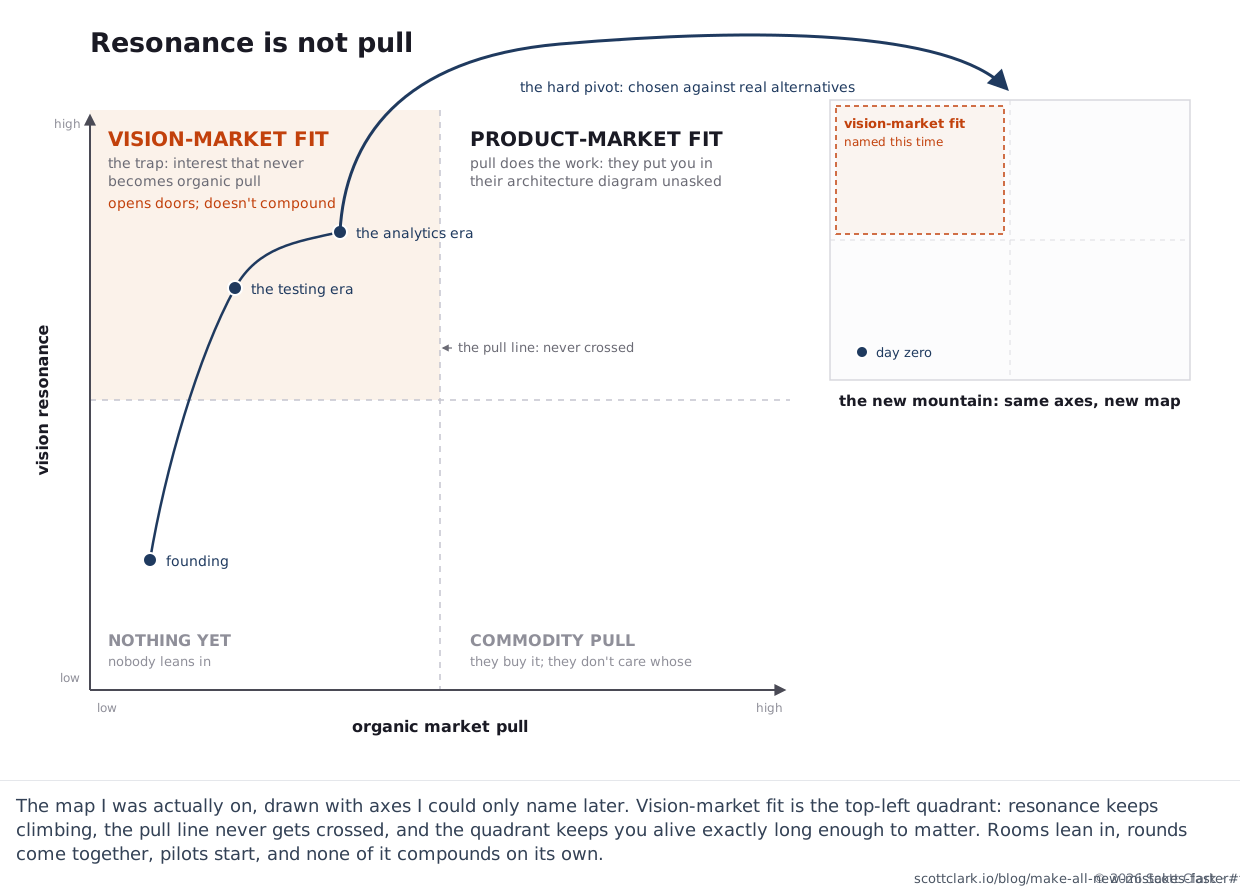
Naming the problem is what makes it escapable. An unnamed false positive just feels like early traction running a little late. A named one is checkable: you can ask, every quarter, what moved this quarter that we didn't push, and write the answer down.
In our case, the answer had been on the page for a while: the doubts that eventually proved decisive were sitting in the margins of our own strategy decks, in our own words, well before I acted on them. Strategy documents archive your disconfirming evidence whether you mean them to or not. And there's an irony worth saying plainly: I spent those years building software to catch the gap between how people assumed their AI systems behaved and how they actually behaved, but people were still figuring out these systems or just YOLOing them into production. The assumption I tested least was the one my own company was standing on: whether people had enough data, risk, and cared enough to actually test rigorously. I still believe the AI-testing market will mature the way I believed it would, but it wasn't maturing on the clock we were running.
Naming the trap also names the way out. The honest process is what you run when the answer keeps coming back "nothing pulled": you test the company against the real market instead of against your own hopes, with real conversations, serious diligence, and real alternatives on the table. You run it not because you've already decided to sell or to stop, but because a choice made against real alternatives is a decision, and a choice made against imagined ones is a story you tell yourself.
The accounting
So here's the honest version, without spin in either direction. Distributional did real work on a real problem, with a fantastic team and investors I'm grateful for, and the plays I imported didn't convert vision into product-market fit. The job of the CEO is to make the business successful and I was burning cash without making enough progress.
I can date the moment the pattern finally clicked into place for me. We were at an onsite with the team and had just had the best sales call in the company's history. They were basically pitching us the whole time, they had our problem, they were looking for our solution, they wanted to pilot as fast as possible. They shared our vision for the future. But when I got back to my room I started doing the math. If this deal went perfectly, if we hit every milestone and didn't catch any enterprise sales drag, then we could convert the pilot in 6 months and lock in our quoted rate. But I knew from SigOpt that there were dozens of things that would need to go right for that to happen, and we would need a dozen deals just like it to hit the numbers we needed, and every other deal in the pipeline was worse than this one. Even if we did great, it wasn't going to be good enough. If the best isn't good enough, you need to play a completely different game.
This led to our first reduction in force and pivot, after 2 years of hard sprinting. Then a similar thing happened again after we pivoted from pre-production testing to post-production analytics. (Read the pivot story here.) So I tried to run a process to find the company a home. We ran the process instead of arguing with it, all the way to the end: term sheets on the table, an offer for the whole team. At the end of the day, that's what made what came next an intentional decision instead of a drift.
We chose a hard pivot over both real alternatives: the exit on the table and the slow burn into nothing. We cleaned it up as well as we could: commitments honored, most of the team landing well together via one of the acquihire offers, and the company coming out the other side pointed at something I believe in even more.
That something is Talaria Scientific, still under the Distributional banner, just a new brand and hard pivot. The short version of the mission: A multi-agent harness for computational science, helping computational scientists research faster, better, and cheaper with AI.
New mistakes, on purpose
What I'm doing differently this time around is not "avoiding mistakes." The goal isn't fewer mistakes; it's newer ones, made faster, against current evidence instead of old wins.
Staying lean: Talaria Scientific today is a team of one plus contractors. Not because scale is bad, but because scale buys speed at the price of rigidity, and rigidity is what slowed my updating last time. Headcount converts hypotheses into commitments. I want my hypotheses cheap to kill for as long as possible, just like I did when building open source from my PhD before starting SigOpt.
Being my own customer: this time the ideal user is me. I spend my days running computational research on PDE neural operators and Bayesian optimization through the product I'm building, and when it's slow or wrong I feel it the same afternoon. The feedback loop went from quarters to hours, which means my gradient information finally comes from the present instead of from 2016.
Sequencing truth before scale: vision-market fit opens doors, and I'm glad for every one, but it isn't the signal to hire against. Product truth first, then pull, then scale, in that order, with the order enforced by keeping the company too small to fake it.
That being said, the answer isn't to invert every play that worked before. Inverting still lets the old data drive: overfitting with a minus sign in front. Some SigOpt lessons transfer just fine. The discipline is holding the old playbook as a prior instead of gospel, weighting it by how much the world has moved, and letting present evidence make the calls. In a market moving this fast, the honest weight on eight-year-old experience is smaller than feels fair.
There's a bigger question underneath all of this, about when to keep climbing the mountain you're on and when to change mountains entirely. Careers have many paths up many mountains, and that idea gets its own post.
For now, the all-new mistakes are underway. I can't tell you which ones they are yet, which is the point: if I could name them, they'd be the old kind. The new map is mostly blank, but one quadrant on it is already named. In a few years Talaria Scientific will have its own list of what worked, and I'm sure I'll look back with all new lessons learned.
Follow me at @DrScottClark to see new posts